

Get to Know: Abigail Nicol
What is your previous job experience?
Before joining the Møller Institute I was a full-time teacher, supporting students through their exams and transition into secondary school. Alongside teaching, I was involved in leading innovative approaches to teaching and learning, implementing strategies at a whole-school level to improve student outcomes.
I couldn’t quite give up my passion for teaching though, so I also set up as a self-employed tutor. Education has always been something I care deeply about, so finding ways to continue working with learners has been really important to me.
Do you have any academic achievements?
I completed a First-Class Bachelor of Education and was awarded an academic scholarship to study for a Master’s in Education. During this time, I became particularly interested in teacher wellbeing and mental health after seeing first-hand the pressures teachers face.
Apparently I wasn’t quite finished studying, as a year later I decided to continue my research and began a Doctorate in Education at the UCL Institute of Education. My research explored the relationship between wellbeing and performance in the workplace, looking at potential parallels between corporate education settings and public education, with the aim of bringing insights back into the public sector.
Like many people, the pandemic reshaped my plans. COVID-19 meant I had to redesign my research when access to schools became impossible, and during this period I also had my children. Balancing work, study and family life eventually led me to pause the doctorate and graduate with a second Master’s in Education instead.
What are you biggest professional and personal achievements?
My greatest personal achievements are, of course, my two children who are now four and one. They are my biggest inspiration and constantly remind me what really matters.
Professionally, one moment that stands out was when Ofsted rated my teaching as Outstanding and asked to film one of my lessons as an example of best practice. It was incredibly rewarding to see the impact of the work I had been doing recognised in that way.
We know you have had quite the progression here at Møller, what made you want to work at the Møller Institute initially, and how has this (if at all) changed?
I made the difficult decision to move away from full-time teaching in order to create more balance and spend more time with family and friends. When I saw the role at the Institute, it felt like the perfect opportunity to stay within education while exploring a new challenge.
I also had a soft spot for Møller already, having worked here waitressing during my college years, so I knew the culture and people would make it a great place to work. Nine years later, that feeling hasn’t changed – if anything, it’s grown stronger.
What appealed to you about this position and led you to join the team?
What really appealed to me was the opportunity to work on learning at a different level. In teaching I was designing lessons and curricula for students, but at Møller I have the opportunity to design programmes alongside organisations, focusing on leadership development and organisational challenges.
I enjoy the variety that comes with that – no two programmes are the same. It’s incredibly rewarding to work with contributors and clients to shape learning experiences that are engaging, relevant and genuinely impactful for participants.
How have you found working at the Møller Institute so far?
The Møller Institute is a genuinely special place to work. The people, the variety of programmes and the opportunity to work with organisations from so many different sectors make every year interesting.
Nine years later and I’m still here, which probably says it all.
Are there any upcoming programmes or projects you’re excited about?
At the moment I’m designing a range of programmes across several sectors, including universities, healthcare, finance and government.
The best part is working with such a wide range of people, from clients to contributors, and collaborating to create learning experiences that really resonate with participants.
How do you spend your free time?
Most of my free time is spent with family and friends, usually trying to keep up with my two energetic children! I also enjoy getting outdoors, whether that’s running at parkrun with my daughter or going for long walks in nature.
What thus far is a project you have thoroughly enjoyed working on / what else do you hope you achieve during your time at the Møller Institute?
I’ve had the opportunity to work with many incredible organisations, but one programme that stands out is the British Council’s Future Leaders Connect programme.
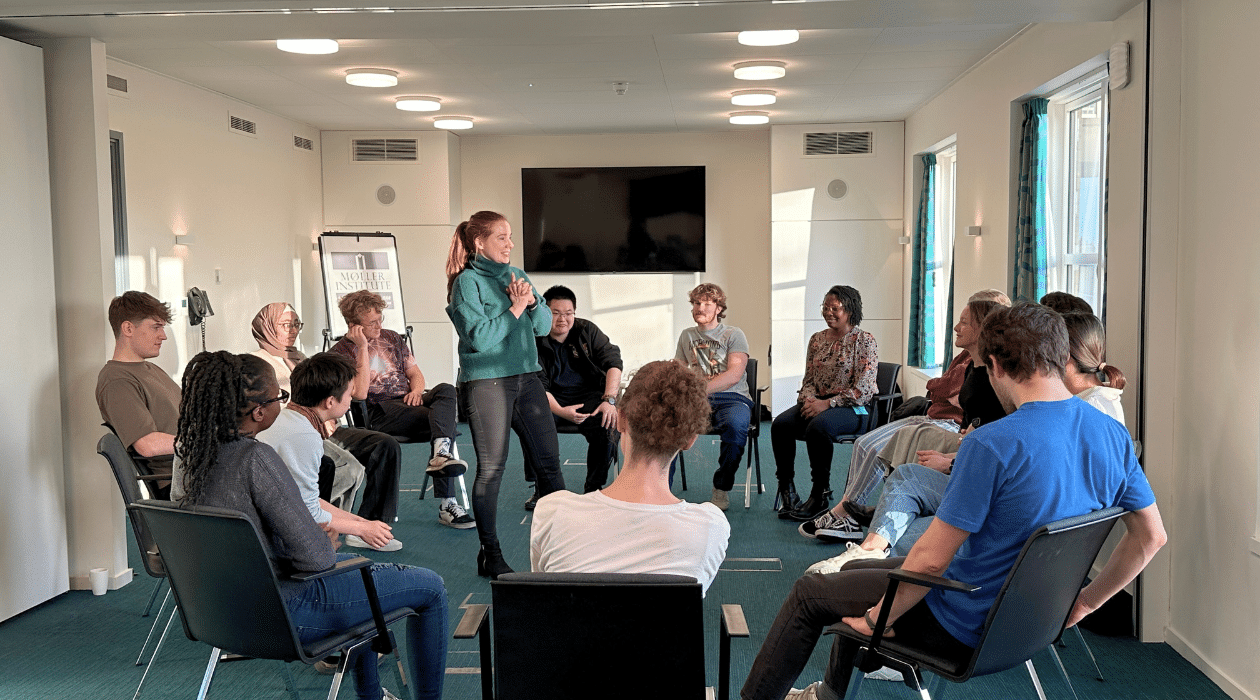
Each cohort brought together around 50 emerging leaders from across the world, representing more than 13 countries. It was inspiring to see such a diverse group of young leaders come together to share perspectives on leadership, policy and global challenges.
One of the highlights was always the College dinners at the end of the week. Participants would share elements of their cultures through dances, poems, songs or prayers – it created such a special atmosphere and was a powerful reminder of the value of bringing different perspectives together.
Looking ahead, I hope to continue designing programmes that have a meaningful impact both on individual leaders and at an organisational level.