

Teacher shortages are not a new phenomenon in the UK or internationally.
In many lower-income and rapidly growing countries, the fundamental issue is that school-age populations and enrolment have grown faster than education systems can recruit and train teachers.
In many higher-income countries, the problem increasingly involves retention and the attractiveness of teaching as a career.
Let’s use the UK as an example. The annual school workforce census reported that since 2025, the number of schoolteachers has decreased by almost 2,000.
Against this backdrop, AI tools offer institutions new ways to make use of limited time and resources.
But alongside these opportunities are important questions about how and where AI should be used in education.
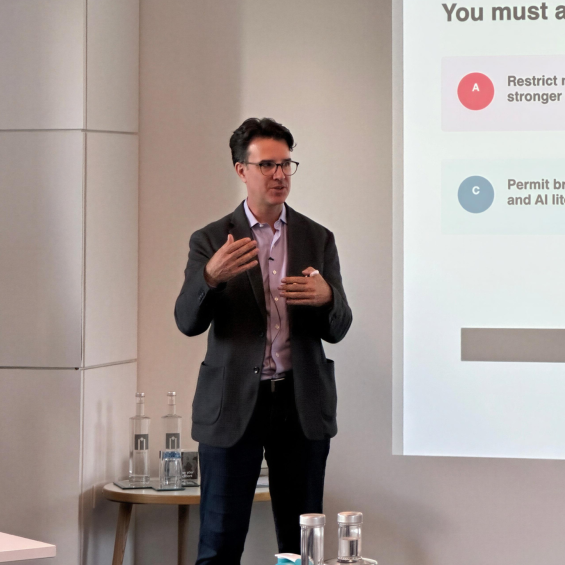
Dr Kevin Martin, Managing Director of the Digital Education Futures Initiative at the University of Cambridge, raised this issue as part of an eight-week programme with us, designed to help education leaders develop strategic roadmaps for using AI within their institutions.
His message was not that education should reject AI. Instead, he encouraged leaders to consider where AI can add educational value, where it can support existing challenges, and where the pursuit of convenience may have wider implications for teaching and learning.
Balancing efficiency with educational value
One of the opportunities AI offers teachers is time.
Lesson planning, resource creation, assessment design, marking, feedback, and administrative tasks are just a few examples of how AI can support teachers and reduce workload.
Used thoughtfully, AI gives teachers more time to focus on their students.
But if teachers need to use AI routinely to produce lessons, resources, and feedback, leaders may need to consider how this affects the role of professional judgement, creativity and expertise.
While education is, in theory, the transfer of information from one person to another, making that knowledge actually stick depends on building relationships, adapting to individual needs, and sharing a passion for what you teach.
This is the kind of teaching that encourages students to push themselves further, think differently, and feel excited about learning something new.
AI therefore presents education leaders with an important consideration: where can greater efficiency improve the educational experience, and where might it remove aspects of teaching and learning that are important to it?
The agency divide
Dr Martin made a key observation during his session:
‘We are in the position of reactivity to tools that are being distributed to us.’
AI is developing quickly, while educational institutions need time to develop policies, assess educational implications and determine where different tools may be appropriate.
This broaches the question:
‘Is technology operating in the world of educators or are educators operating in the world of technology?’
The reality is more complicated than either scenario.
Some technology companies are developing tools specifically for education and working with educators in the process. As Dr Martin described it, the relationship ‘flows both ways’.
However, institutions are approaching these developments from very different starting points.
Many face teacher shortages, increasing workloads, constrained budgets and growing expectations from students and staff. In these circumstances, AI may offer practical ways to support areas where existing resources are under pressure.
This is what Dr Martin called ‘the agency divide’.
Institutions with enough time, expertise and resources can experiment with AI, evaluate its impact and make deliberate decisions about where it belongs. Those operating under greater pressure may have to adopt the same technologies to maintain existing levels of provision.
The gap between these two scenarios shows the significance of Dr Martin’s session. And it shows that it’s more important than ever for educational leaders to create a clear strategy that assesses the opportunities and implications of AI in their own context, rather than letting technological change determine how it is used.
Implementing change
Technological advancements will continue, and educational institutions need to consider how they will respond.
The basis of the participants’ roadmaps was to move from reactive adoption towards intentional adoption. On programme completion, participants planned to present their roadmaps to key stakeholders within their institutions, outlining where and how they believe AI could play a role.
However, introducing new approaches can come with barriers. Not everyone likes change, and as a result, different perspectives emerge on what should and shouldn’t be introduced.
Drawing on Clayton Christensen’s theory of disruptive innovation, Dr Martin explored what can happen when new approaches emerge alongside established ways of doing things.
He used Netflix and Blockbuster as an example. Blockbuster dominated American home entertainment for years, while Netflix introduced a new, convenient way for people to watch films. As technology and consumer expectations changed, so did the industry. Since Blockbuster didn’t adapt to technological change, it was eventually phased out.
Education is experiencing its own period of technological change. But recognising the case for a new approach is only one part of the participants’ process. They will need to communicate their roadmaps to people who may hold different views about AI and its role in education.
Dr Martin drew on Geoffrey Moore’s Crossing the Chasm theory to illustrate the gap that can emerge between early adopters, who are more willing to experiment with new ideas, and pragmatists, who look for greater evidence and reassurance before adopting them.
For education leaders developing an AI strategy, understanding these different perspectives can help when introducing new ideas across an institution.
Dr Martin illustrated this through his own experience working on HIV/AIDS education in rural East Africa. He found that younger people within communities were more receptive to new information and approaches. However, they did not necessarily have the influence needed to bring the wider community with them.
To ensure new ideas were considered, Dr Martin shared that it was about understanding who the influential members of the community were and building relationships with them based on trust and respect.
For participants preparing to present their roadmaps, Dr Martin’s example highlights that creating change requires understanding whose support is needed, what matters to them, and what evidence or reassurance will help them engage with the proposed changes.
Overall, AI can help the education sector address some of its most pressing challenges, including limited resources. Dr Martin’s message to participants was that the way institutions respond matters. By developing clear roadmaps, education leaders can move away from reacting to technological change and make informed decisions about how to use it to their advantage, ensuring that students continue to receive education that supports their growth and encourages curiosity.