



In the high-stakes arena of legal services, a merger is often viewed through the cold, hard lens of a balance sheet. Partners pore over Profit per Equity Partner (PEP), turnover growth, and geographic footprints.
However, the legacy of a deal – and the legacy of the leader – is rarely defined by the initial deal announcement but delivered through the grueling process of post-merger integration that follows. Central to any successful integration is the culture.
For professional service firms (PSFs), culture is in no way a “soft” metric; it is the very fabric of the firm’s value. Culture is how the firm actually works day to day and what is valued – the “smell of the place” as Sumantra Ghoshal memorably put it. As the famous quote goes “Culture eats strategy for breakfast”.
The professional service paradox
Unlike manufacturing, where assets are physical and stationary, the principal assets of a law firm are mobile, intelligent, often insecure, high-achieving professionals who walk out of the door every evening. In this environment, management cannot rely on rigid command-and-control structures. Leading a law firm is akin to “organising a high school dance” (Empson) – the leadership can set the stage, but they cannot force the partners to dance with one another.
The “glue” that holds this together is not a manual of procedures, but the culture and personal relationships among the lawyers and support teams. When two firms merge, you are not just combining IT systems and office leases; you are attempting to weave together two distinct social fabrics. If the cultures are fundamentally misaligned, the reputation and brand of the firm will quickly erode.
Analysing the cultural DNA: Initial steps
Before the ink is dry on any letter of intent, a rigorous cultural audit is required. This goes beyond superficial “values” statements. To truly understand a potential partner’s culture, leadership should:
- Audit the Cultures: through surveys and analytical tools, a detailed view of the culture, values, and behaviours of a firm can be identified together with the hot spot areas where leaders may need to give extra attention.
- Follow The Money: Culture is often revealed by how a firm rewards its people. Is the compensation system “lockstep” or “eat-what-you-kill”? A merger between a collaborative, shared-pool firm and a highly individualistic, performance-driven one will face immediate internal friction.
- Map Informal Networks: Use Social Network Analysis to see how work actually gets done and how decisions are discussed and implemented. In PSFs, power often resides in informal clusters rather than the organisational chart. If these clusters are closed off to outsiders, integration may stall.
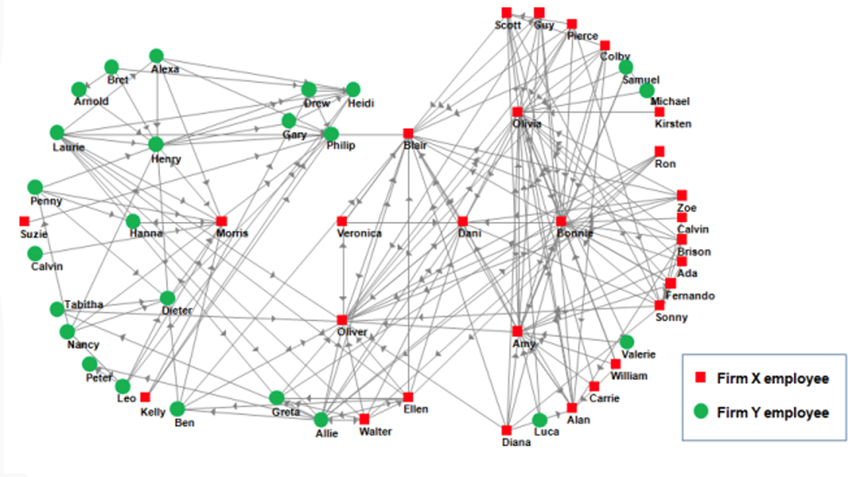
Network mapping of two post-merger firms
- Evaluate “Client Stewardship”: Does the partner own the client, or does the firm? Cultural clashes often erupt when one firm treats clients as personal “fiefdoms” while the other expects a multidisciplinary, institutional approach.
- Begin planning early: the post-merger integration plan needs to be drafted and agreed well before the deal is signed. It should be aligned around releasing the value that will be created through the combination of two firms.
Delivering the integration: Turning two firms into one
Successful post-merger integration (PMI) is a marathon, not a sprint. The first year is critical for building momentum, unifying the platform, and establishing a climate of trust and mutual understanding. Without trust, partners will not take the risks necessary to refer work to their new colleagues.
Year 1: Building the foundation
The primary goal in the first twelve months is to manage the “post-honeymoon dip” that typically occurs 6–12 weeks after the deal closes, when reality sets in and partners begin to ask, “Why did we do this?”.
- Establish a unified platform: Setting clear reporting lines as quickly as possible is essential. Operational integration—IT/ PMS, billing systems, and premises—must be sorted in Year 1 to remove daily frustrations that can be misattributed to “cultural differences”.
- Mix the teams: Don’t let legacy silos persist. Actively mix teams across offices and projects to force new social bonds.
- Communicate success stories: From the second quarter onwards, highlight “wins” that were only possible because of the merger to build momentum.
Years 2 and 3: Capitalising on the union
By the second year, the word “integration” should be dropped from the firm’s vocabulary. The focus must shift from “combining” to “performing.”
- Unified culture: Leaders must commit to a single, non-negotiable culture rather than a “best of both” compromise that pleases no one.
- Internalise lessons: The most successful firms are “serial mergers” who treat integration as a repeatable, systematised skill.
Case study: The cultural challenge of the transatlantic “Super-firm”
Recently, many USA/UK mergers have occurred, creating a new global elite – for example, the 2024 merger between Magic Circle firm Allen & Overy (A&O) and Shearman & Sterling which created a global elite law firm with over $3.5 billion in revenue.
However, while the strategic rationale may clear, the cultural integration for many such mergers is a useful case study in the differences between two different legal traditions, especially where differing reward and recognition systems exist.
The disparity: “Magic Circle” vs “Wall Street”
Many US/UK mergers face immediate cultural hurdles due to the distinct operational DNAs:
Compensation philosophy: Historically, many UK firms have lent toward a modified “lockstep” system (rewarding seniority and collaboration), whereas many US firms have operated in the highly competitive, performance-driven U.S. market where individual “rainmaking” is prioritised and the focus more on pure financial performance. Reconciling these models is often the single most contentious point in transatlantic mergers.
Management style: Some UK firms bring a more institutionalised, consensus-driven European approach, whilst many US firms’ heritage and traditions are rooted in a more traditional, partner-led “Wall Street” hierarchy.
Lessons learned: The cultural issues need to be actively managed by leadership, with reward and recognition being a central process to get right.
Conclusion: Culture is key to the success of a law firm merger
In creating a successful law firm merger, it is not enough to rely on the financial metrics, new offices, new clients, or a search for scale. The success or failure of the new endeavour will ultimately be determined by whether you can win the hearts and minds of your partners to create a sustainable and successful culture.